A standing seam roof is not a better shingle. It is a different category of roof with a different failure mode, a different price, a different set of things that must go right during installation, and a different conversation with your insurer. This site sets out what the product actually is, the handful of St. Louis situations where it genuinely earns its cost, and the larger number where a good asphalt roof is the right answer and a metal roof is an expensive way to solve a problem you do not have.
Panels run ridge to eave, and the fasteners hide under the seam
On a shingle roof, every course is nailed through its face and covered by the course above it. On a standing seam roof, a flat panel runs the full length of the slope, from ridge to eave, in one unbroken piece. Where two panels meet, their edges turn up and lock together into a raised rib that stands proud of the water plane. That rib is the seam, and the whole roof is named after it.
The fastening happens under that rib. Clips are screwed to the deck along the panel edge, the next panel hooks over them, and then the seam is closed over the top. When the roof is finished there is nothing screwed through the flat of the panel where water runs. The metal you can see has no holes in it.
That single detail is most of the argument for the product. It also draws the line between standing seam and the cheaper corrugated metal that gets sold under the same two words, where the screws go straight through the ribs from above and each one carries a rubber washer that sits in the Missouri sun for the rest of its life. Those washers are the part that eventually fails. The difference is worth its own page.
Almost every roof in St. Louis is asphalt, and that is not an accident
Drive any street in Maplewood, Affton, Florissant or University City and count the metal roofs. You will not need both hands. The housing stock here is brick and frame, mostly cut up with hips, dormers, additions and porches added over a century, and asphalt is cheap, fast, forgiving of an imperfect deck, and repairable one square at a time. A standing seam roof is the opposite of all four of those things.
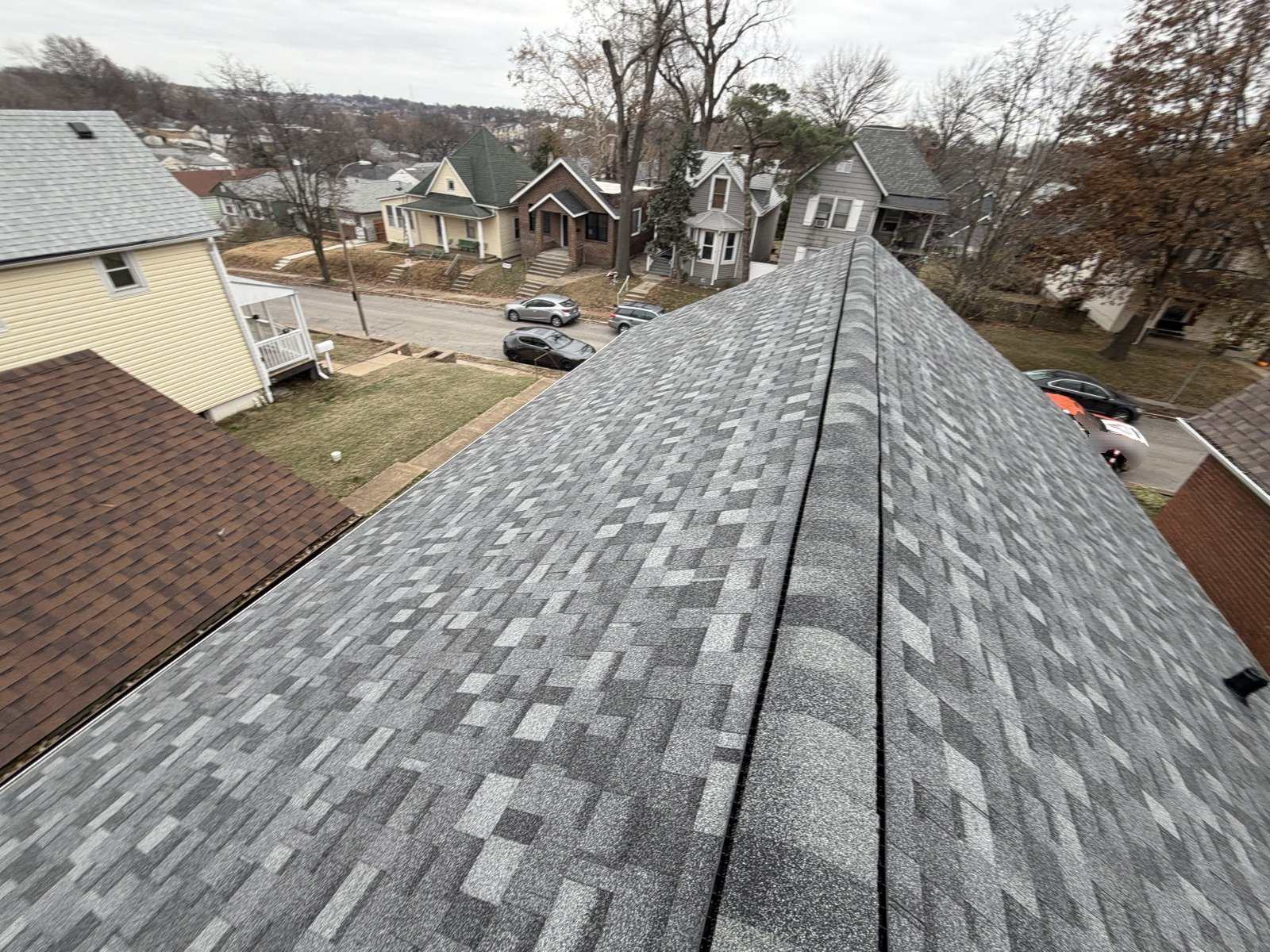
None of that means metal is a bad product. It means metal has to earn its place against a default that is genuinely good at its job. The places where it does earn it are specific, and they are mostly about slope and about long unbroken runs. That is the next page.
What you gain, and what you give up
No holes where the water runs
Nothing is screwed through the field of the panel. There is no rubber washer sitting in direct sun waiting to go hard and crack, which is the single most common way an exposed fastener metal roof begins to leak.
It works at slopes where an asphalt shingle is out of its depth, which is why a low pitched porch or a shallow rear addition is the most common honest reason to specify it.
It sheds snow, and a properly installed seam and clip system resists wind uplift well. There is no granule loss, because there are no granules.
Money, tolerance and easy repairs
It costs substantially more up front than an asphalt roof on the same house, and the gap is widest on a cut up roof with a lot of flashing and short panel runs.
It demands a flat, true deck. Panels are large flat planes and they telegraph every wave, cupped board and sagging rafter underneath. A shingle hides that. Metal advertises it.
It is unforgiving of a bad installation in a way shingles are not, and a repair usually means undoing a seam rather than swapping a square of material.
If you read only one thing on this site, read that pair of columns twice. Most bad metal roof decisions in this market are not about the metal at all. They are about somebody buying the left column without pricing the right one.
Metal is very unlikely to leak from hail. It is very likely to dent.
This is the part of the conversation that goes wrong most often in St. Louis, because the two halves of it get collapsed into one. A standing seam panel is a continuous sheet of coated steel or aluminium over a solid deck. Hail that would bruise an asphalt shingle, knock the granules off it and start the clock on its life will usually not put a hole in metal. Leak risk from hail on a correctly installed standing seam roof is low.
Dents are a different question. Large stones dent panels, and a dented panel is still watertight while looking permanently bad from the street. That combination has a name in insurance policy language: cosmetic damage. Many carriers now attach a cosmetic damage exclusion or a separate cosmetic waiver to metal roofs specifically, which means the dents may not be covered even when the roof is otherwise insured.
For the record on the local weather, NOAA logged 125 hail events in St. Louis County between 2020 and 2025, with a maximum reported stone of 2.5 inches and an average around 1.32 inches. St. Charles County logged 54 over the same window, Jefferson County 44 and Franklin County 30.
Source: NOAA Storm Events, hail reports 2020 to 2025, by county. These are counts of LOGGED REPORTS, not insured losses and not damaged roofs. A report exists because a person saw hail and told somebody, so reporting density tracks population: a dense county produces more reports than an empty one from identical weather. Treat the numbers as evidence that this is a hail market, not as a damage tally.
Changing material changes the permit conversation
In unincorporated St. Louis County, a like for like asphalt reroof on a slope of 4:12 or steeper does not require a permit. Three things change that: a slope below 4:12, replacing more than a quarter of the decking, or changing the roofing material. Putting standing seam metal on a house that currently wears asphalt is a material change, so plan on a permit, and on the inspector caring about what is under the panels as much as about the panels themselves.
Municipalities inside the county set their own rules on top of that. Ballwin and Kirkwood run their own contractor licensing, so a roofer who is fine in one municipality may not be registered in the next. In St. Charles County, do not take a rule off a web page, including this one: call the county building division that covers your address and ask them directly, because the published guidance is inconsistent and the answer depends on your municipality.
Nine pages, each one answering a question people actually ask
What a standing seam roof actually is
Panels, clips, seam profiles, gauge, and the difference between a snap lock seam and a mechanically seamed one.
02Concealed and exposed fasteners
The cheaper product sold under the same two words, why its washers perish, and how to tell them apart from the ground.
03Where a metal roof earns its cost
Low slope sections, long unbroken runs, porches and additions, and the one argument that is actually about geometry.
04Where standing seam is the wrong roof
Cut up roofs, heavy penetration counts, tight budgets and the honest case for a good asphalt roof instead.
05Hail, dents and your policy wording
Why metal rarely leaks from hail, why it dents, and the exclusion to read before you commit.
06The deck underneath
Plank decking, telegraphing, underlayment, and why the deck matters more under metal than under anything else.
07What drives the price
Panel runs, seaming labour, trim fabrication and the line items that make two metal quotes incomparable.
08Snow, ice, noise and movement
Snow shedding and where it lands, ice dams, the rain noise myth, and thermal movement that ticks.
09Questions before you commit
The evidence to demand from a metal installer, and who to ask when the honest answer is not us.
Panels, clips, seam profiles and the three specifications that make two quotes comparable.